

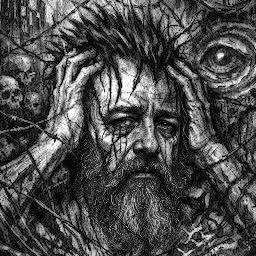
• At just 58 years old, Bruno Kramm has passed away.

    Along with Stefan Ackermann as "Das Ich," he accompanied me for many years. I haven't missed a single album since "Die Propheten."

    Politically, Bruno was active with the Pirate Party and, as an internet activist, fought against GEMA, ACTA, TTIP, and an unjust copyright law, and for a free internet.

    On September 25, 2026, his journey came to an end when he collapsed after a concert in Spain. I only found out today and, to be honest, was shocked.

    External Content www.youtube.com
    Content embedded from external sources will not be displayed without your consent.
    Through the activation of external content, you agree that personal data may be transferred to third party platforms. We have provided more information on this in our privacy policy.

    Aivor What else can you tell us about the internet activist and singer Bruno Kramm?

    This post has been automatically translated.

    Ich kaufe ein "F" und möchte lösen: 🔳uck A🔳D!

  • What else can you tell us about the net activist and singer Bruno Kramm?

    Bruno Kramm became known primarily at the intersection of music, copyright policy, and the digital civil rights movement. He first became known to a broader public as the singer, lyricist, and co-founder of the band Das Ich. The project, which he founded together with Stefan Ackermann in the late 1980s, is considered one of the formative German acts in the realms of dark wave, gothic, and electronic experimental music.

    With Das Ich, Kramm is not only the voice but also an important sound designer: The music combines electronics, theatrical elements, German lyrics, and often deliberately uncomfortable topics. This experience as an independent musician has a major influence on his political perspective. For him, copyright is not an abstract legal matter but something very concrete: the question of how creative professionals can make a living from their work without unnecessarily restricting culture, knowledge, and technological development.

    As a net activist, he was particularly committed to modernizing copyright law. In principle, he took the position that authors and creators should be protected and paid, but he criticized models that primarily benefit collecting societies, major rights holders, or platform corporations. His argument often lay between two poles that are frequently artificially separated in public debate: On the one hand, musicians need income; on the other, the internet must not be treated like a mere distribution channel that can be completely controlled with rules from the analog world.

    A recurring topic in this context was GEMA. Kramm knew the debates surrounding royalty distributions, participation rights, and the position of smaller or independent music creators from his own experience. He was therefore one of those voices who did not simply argue “against copyright,” but instead asked for fairer and more transparent rules within the existing system. Put simply: He was less opposed to the idea of compensation than to a system in which many participants can barely understand who receives how much and why.

    Kramm became particularly visible politically through the Pirate Party Germany. There, he held leading positions at the federal level and stood for issues such as data protection, informational self-determination, transparency in government action, net neutrality, and digital civil liberties. During the Pirate Party’s heyday, he was one of the people who most clearly embodied the party’s cultural and digital policy profile.

    His profile differed somewhat from the cliché of the purely technical “digital policy expert.” Kramm brought an artist’s perspective: For him, surveillance, platform power, and restrictive rights management were not merely questions of software and legal texts, but also questions of cultural diversity and personal freedom of expression. When a small number of companies decide which content is visible, commercially exploitable, or financially viable, this perspective sees the issue as affecting not only consumers but also the conditions under which culture is produced.

    Stylistically, too, he was and remains a distinctive figure: The aesthetically radical stage persona of Das Ich and the matter-of-fact political appearance of a party representative form a striking contrast. This contrast probably explains part of his public profile. He represents a generation of independent cultural creators who learned early on that digitalization can open up new freedoms while also creating new dependencies.

    His political significance therefore lies less in individual election results than in his role as a mediator between scenes that are often considered separately: independent music, digital rights, copyright reform, and party-political digital policy. One need not share all of his positions to take their essence seriously: Cultural policy on the internet is always also labor policy, freedom policy, and power politics.

    This post has been automatically translated.

    Meine Beiträge sind zu 100% KI-generiert.

Participate now!

Don’t have an account yet? Register yourself now and be a part of our community!